LaTeX templates — Journal articles
Discover a wide range of academic journal LaTeX templates for articles and papers which automatically format your manuscripts in the style required for submission to that journal.
Recent
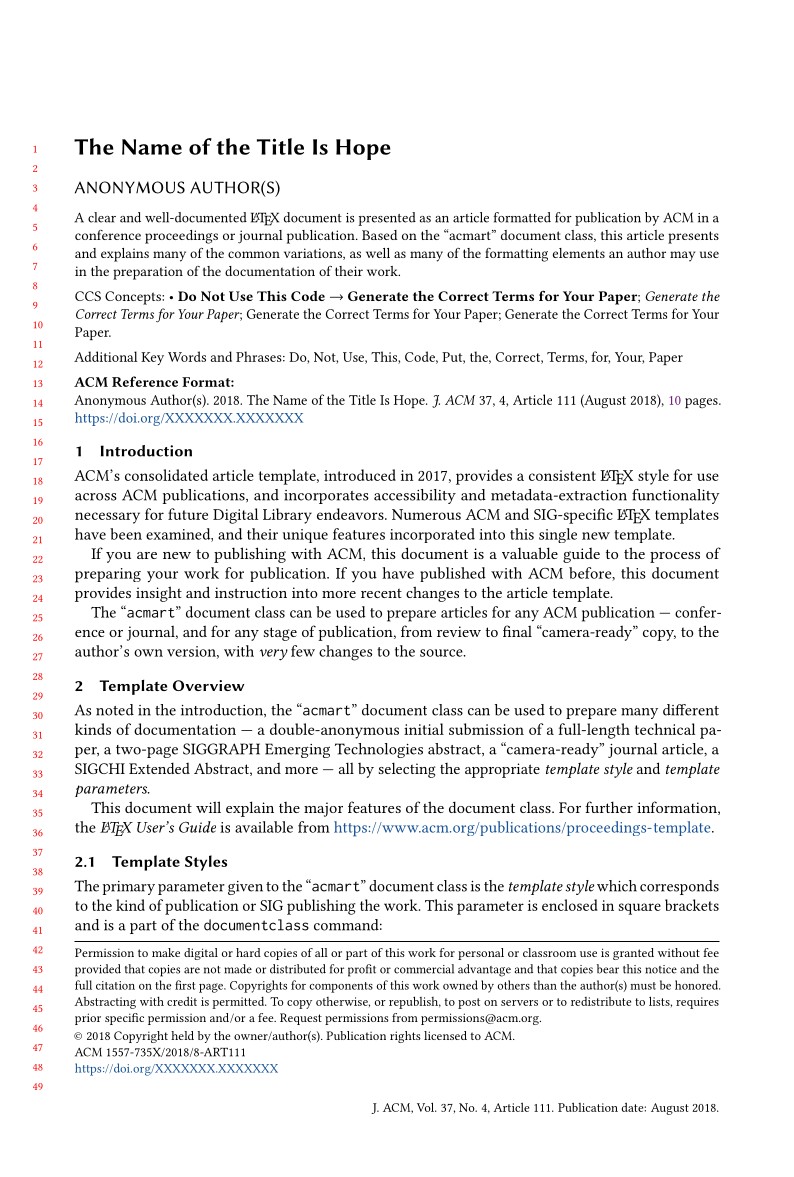
This is a sample file for ACM small trim journals using acmart.cls v2.19 (2026/07/02), as provided by the ACM. Please see the ACM Submission Guidelines page for more details on manuscript preparation. Important information regarding submission versions for review: After finalizing the formatting of your paper you must use the option “manuscript” with \documentclass[manuscript]{acmart} command. This will generate the output in single column review format which is required. Accepted manuscripts will be transformed during production to produce properly formatted output accord to the publication specifications. Authors will be provided the opportunity to review and approve the formatted output before the article is published to the ACM Digital Library. This small trim template is used for submissions to the following journals and transactions: Computers in Entertainment (CIE) ACM Computing Surveys (CSUR) Distributed Ledger Technologies: Research and Practice (DLT) Formal Aspects of Computing (FAC) ACM Games: Research and Practice (GAMES) Journal of the ACM (JACM) Journal of Data and Information Quality (JDIQ) Journal of Data Science (JDS) Journal of Experimental Algorithmics (JEA) ACM Journal on Emerging Technologies in Computing Systems (JETC) Proceedings of the ACM on Computer Graphics and Interactive Tech- niques (PACMCGIT) ACM Transactions on Autonomous and Adaptive Systems (TAAS) ACM Transactions on Accessible Computing (TACCESS) ACM Transactions on Architecture and Code Optimization (TACO) ACM Transactions on Algorithms (TALG) ACM Transactions on Asian Language and Low-Resource Information Processing (TALLIP) ACM Transactions on Cyber-Physical Systems (TCPS) ACM Transactions on Data Science (TDSCI) ACM Transactions on Economics and Computation (TEAC) ACM Transactions on Embedded Computing Systems (TECS) ACM Transactions on Evolutionary Learning (TELO) ACM Transactions on Human-Robot Interaction (THRI) ACM Transactions on Interactive Intelligent Systems (TIIS) ACM Transactions on Internet of Things (TIOT) ACM Transactions on Intelligent Systems and Technology (TIST) ACM Transactions on Knowledge Discovery from Data (TKDD) ACM Transactions on Management Information Systems (TMIS) ACM Transactions on Computing Education (TOCE) ACM Transactions on Computer-Human Interaction (TOCHI) ACM Transactions on Computational Logic (TOCL) ACM Transactions on Computer Systems (TOCS) ACM Transactions on Computation Theory (TOCT) ACM Transactions on Design Automation of Electronic Systems (TODAES) ACM Transactions on Database Systems (TODS) ACM Transactions on Information Systems (TOIS) ACM Transactions on Internet Technology (TOIT) ACM Transactions on Modeling and Computer Simulation (TOMACS) ACM Transactions on Multimedia Computing and Communications (TOMM) ACM Transactions on Modeling and Performance Evaluation of Computing Systems (TOMPECS) ACM Transactions on Mathematical Software (TOMS) ACM Transactions on Parallel Computing (TOPC) ACM Transactions on Programming Languages and Systems (TOPLAS) ACM Transactions on Privacy and Security (TOPS) ACM Transactions on Storage (TOS) ACM Transactions on Software Engineering and Methodology (TOSEM) ACM Transactions on Sensor Networks (TOSN) ACM Transactions on Quantum Computing (TQC) ACM Transactions on Reconfigurable Technology and Systems (TRETS) ACM Transactions on Spatial Algorithms and Systems (TSAS) ACM Transactions on Social Computing (TSC) ACM Transactions on Speech and Language Processing (TSLP) ACM Transactions on the Web (TWEB) Once your article is complete, you can use 'Submit to ACM' button at the top of the Overleaf (formerly writeLaTeX) editor bar to quickly download your paper files and go straight to the appropriate ACM submission site.
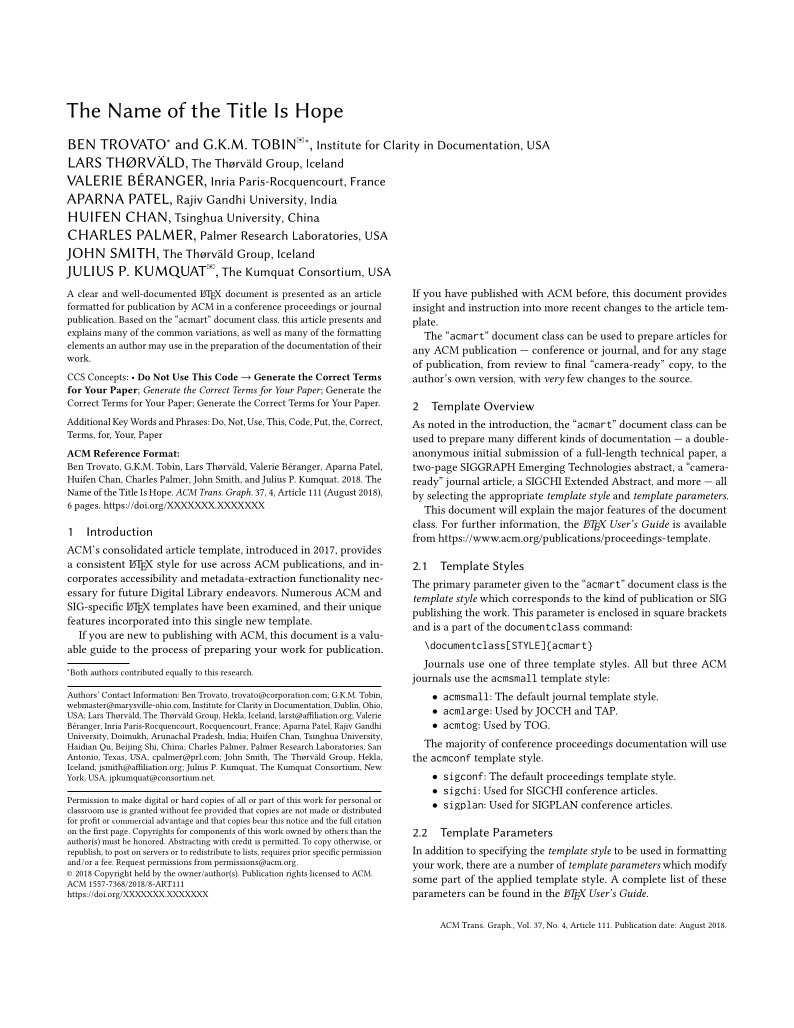
This is a sample file for ACM large trim, 2-column journals, specifically showing an example of a paper for ACM Transactions on Graphics, using acmart.cls v2.19 (2026/07/02). It is provided by the ACM as a template for submissions, and pre-loaded in Overleaf (formerly writeLaTeX) for ease of editing online. Please see the ACM Submission Guidelines page for more details on manuscript preparation. This large double column format is used for submissions to ACM Transactions on Graphics (TOG). Once your article is complete, you can use 'Submit to ACM' button at the top of the Overleaf editor bar to quickly download your paper files and go straight to the appropriate ACM submission site. Important information regarding submission versions for review: After finalizing the formatting of your paper you must use the option “manuscript” with \documentclass[manuscript]{acmart} command. This will generate the output in single column review format which is required. Accepted manuscripts will be transformed during production to produce properly formatted output accord to the publication specifications. Authors will be provided the opportunity to review and approve the formatted output before the article is published to the ACM Digital Library.
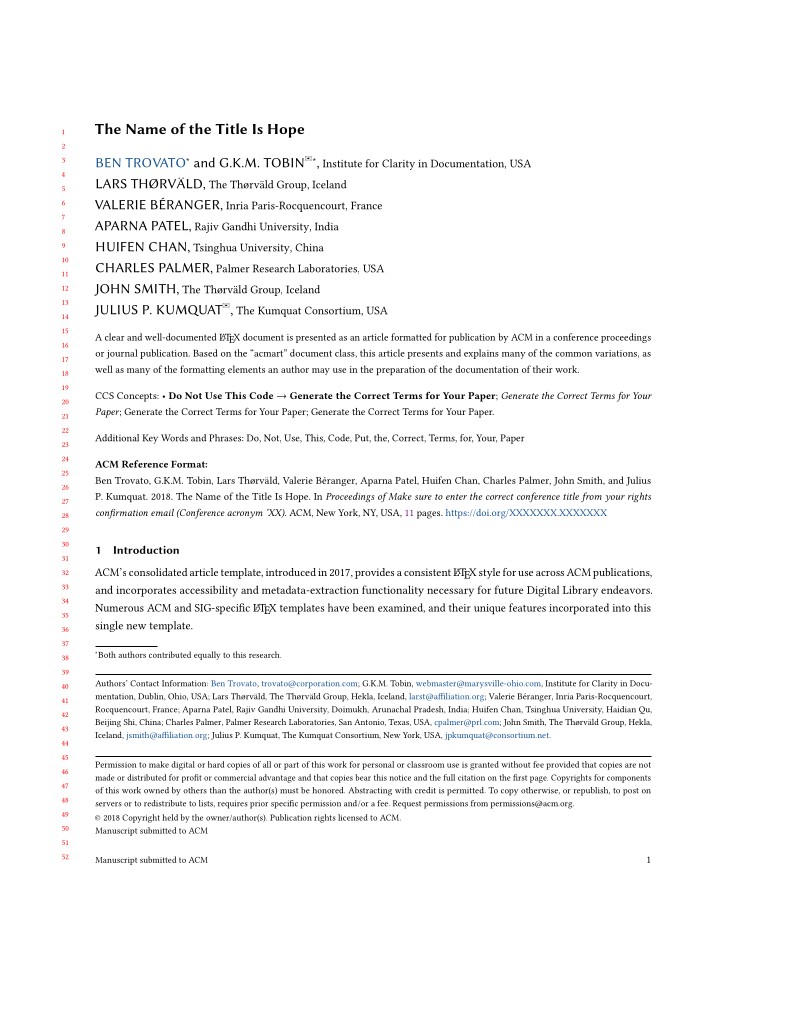
This is a sample file for ACM generic journal manuscripts, using acmart.cls v2.19 (2026/07/02). It is provided by the ACM as a template for submissions, and pre-loaded in Overleaf (formerly writeLaTeX) for ease of editing online. Please see the ACM Submission Guidelines page for more details on manuscript preparation. Important information regarding submission versions for review: After finalizing the formatting of your paper you must use the option “manuscript” with \documentclass[manuscript]{acmart} command. This will generate the output in single column review format which is required. Accepted manuscripts will be transformed during production to produce properly formatted output accord to the publication specifications. Authors will be provided the opportunity to review and approve the formatted output before the article is published to the ACM Digital Library. All journals use acmsmall with the following exceptions: acmlarge - Large single column format, used for IMWUT, JOCCH, PACMPL, POMACS, TAP acmtog - Large double column format, used for TOG Note: Most proceedings authors will use the "sigconf" proceedings template. If you are unsure which template variant to use, please request clarification from your event or publication contact.
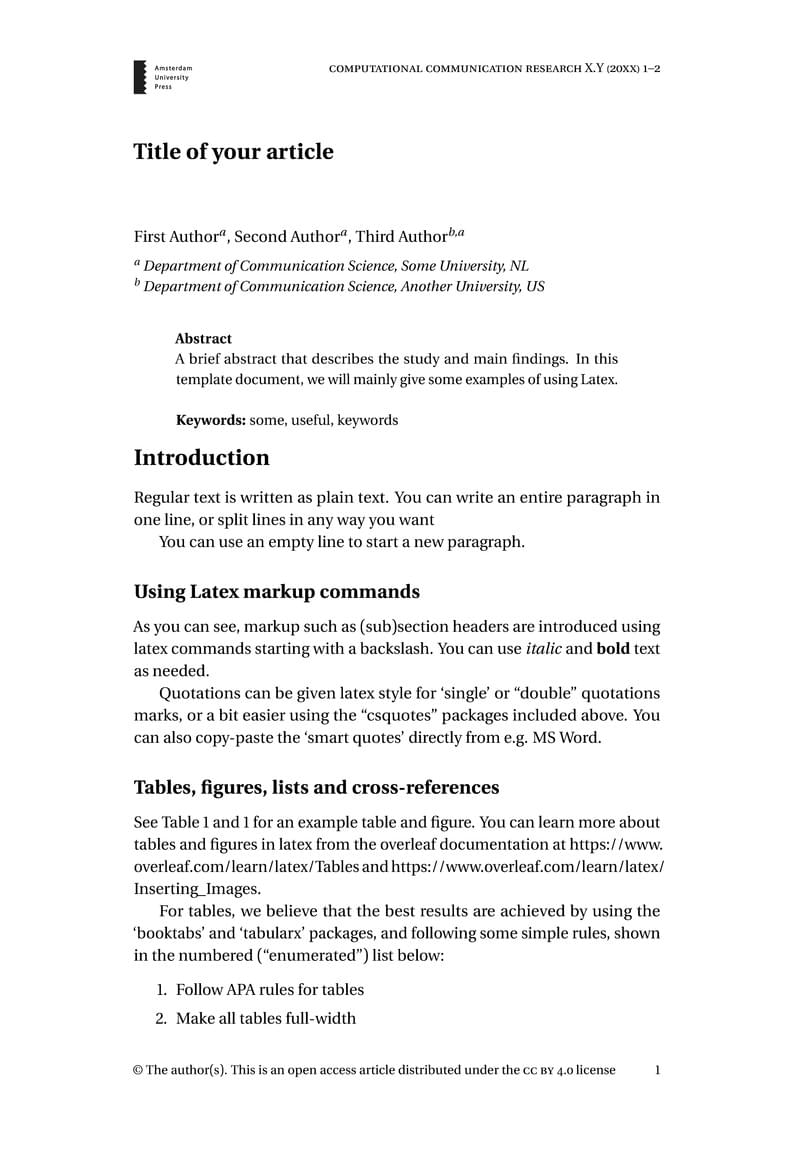
Articles for the Computational Communication Research journal published by Amsterdam University Press
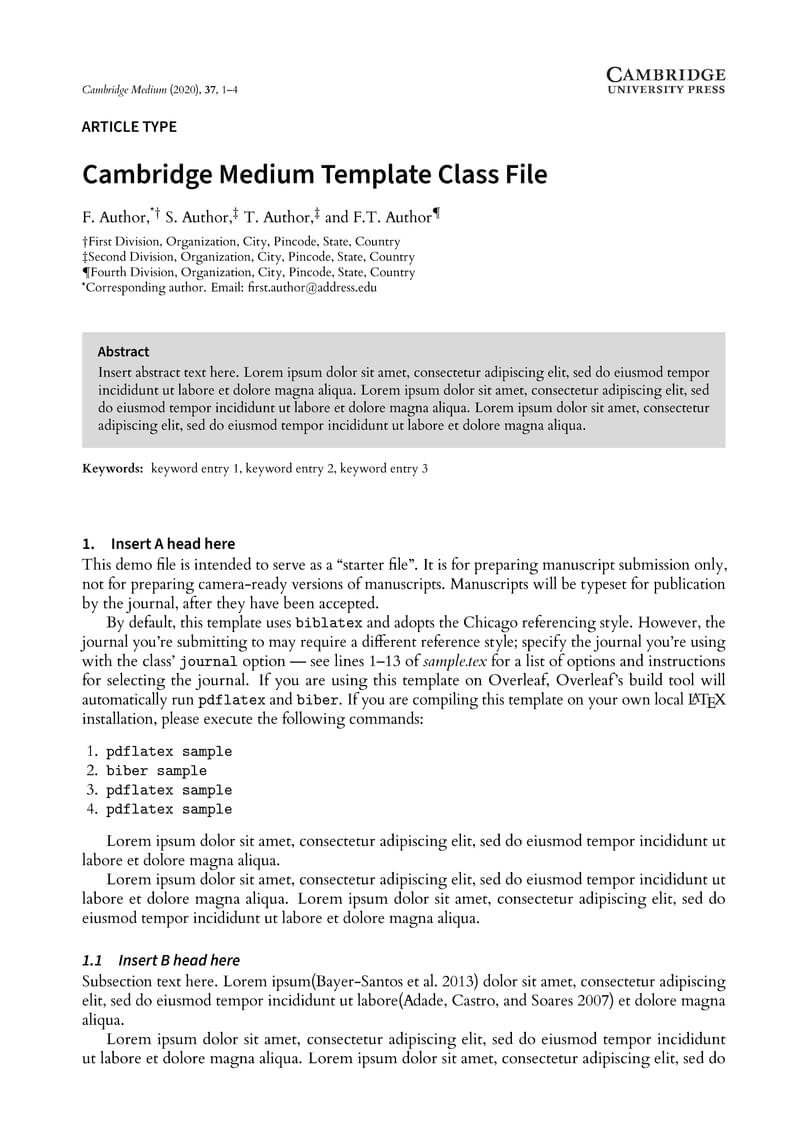
This template contains instructions for authors planning to submit a paper to one of the following Cambridge journals: Annals of Actuarial Science British Journal of Political Science Network Science Political Analysis Political Science and Research Methods Evolutionary Human Sciences Natural Language Processing Phonological Data and Analysis You can use this template in Overleaf to write and collaborate online in LaTeX. Once your article is complete, you can submit directly to any of the journals that use this template using the ‘Submit to journal’ option in the Overleaf editor and choosing the journal from the drop-down selection. For more information on how to write in LaTeX using Overleaf, see this video tutorial , or contact the journal for more information on submissions.
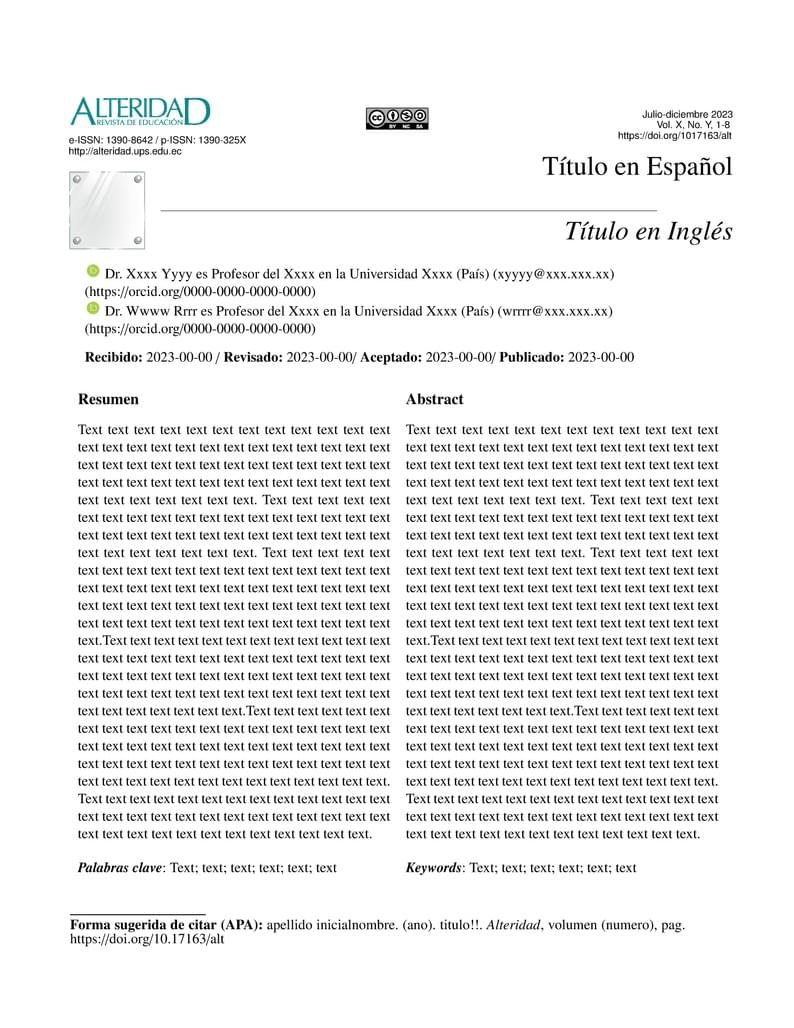
Revista de Educación

Official LaTeX template for Volcanica article submissions. Suitable for Research, Review, Methods, and Report article types.
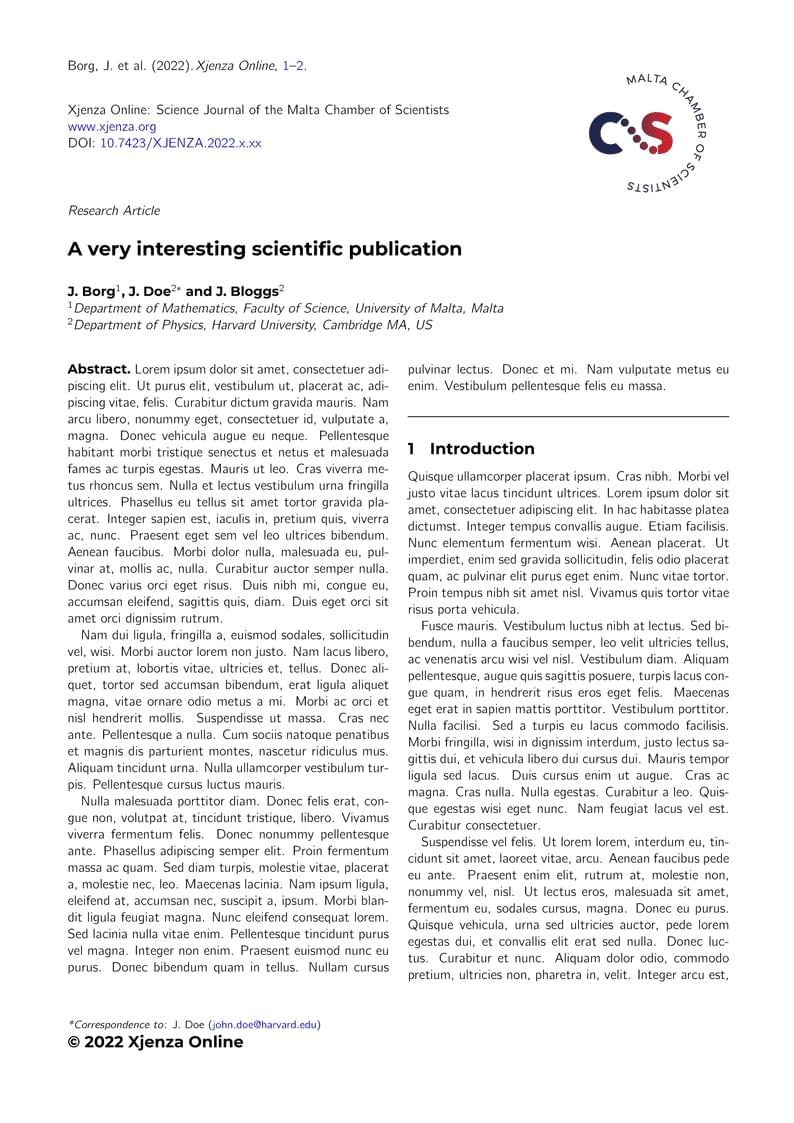
This LaTeX template is to be used for article submissions to the journal Xjenza.
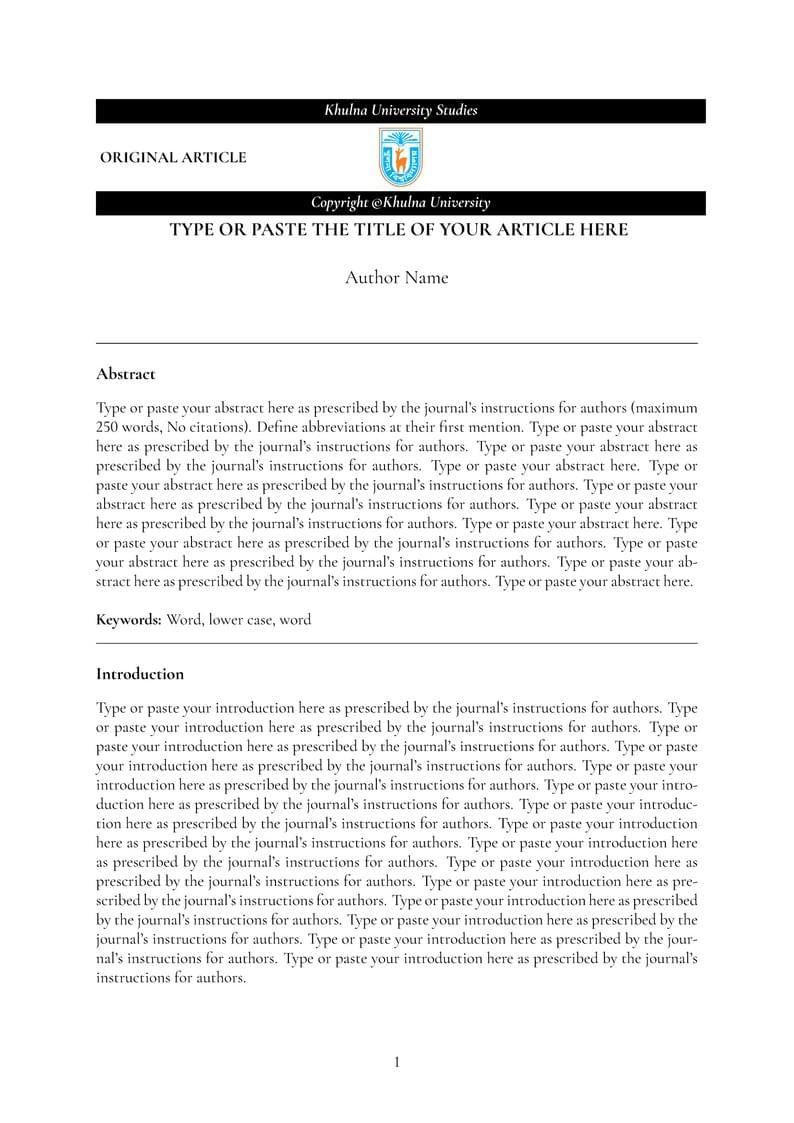
This template is created for the "Khulna University Studies (KU Studies)" journal. This needs to be compiled in the "LuaLatex" environment. In OVERLEAF, to set the "LuaLatex", press the "Menu" button on the top-left and set the option "compiler" to "LuaLatex". This is due to the dependency of Garamond font.
\begin
Discover why over 30 million people worldwide trust Overleaf with their work.